Mexicon Vol. 48 (2026)
John G. Hodgson, John E. Clark and Ayax Moreno
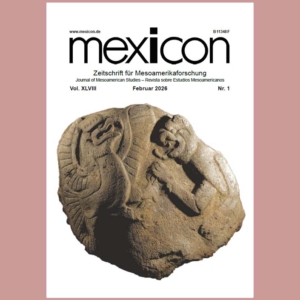
A New Olmec Sculpture from Coastal Chiapas, Mexico
(Mexicon 48.1, February 2026: 7-14)
Abstract: In this article, we present information about a newly discovered monument at Ojo de Agua, a late-early formative site located in the Mazatán region on the coast of Chiapas, Mexico. The dates from Ojo de Agua indicate that the monument cannot be dated later than 1100–1000 BCE and may date to 1200–1300 BCE (Cal.). Here, we describe the basic iconographic content of Monument 5 and provide descriptions of 4 other Olmec monuments from the site. The discovery of Monument 5 supports our idea that the site was an Olmec regional center in Soconusco. We believe with excavation further finds of sculpture at the site will help to reconstruct the chronology of Olmec-style sculpture and an understanding of Gulf Coast and Highland Olmec presence on the Pacific coast.
Resumen: En este artículo, presentamos información sobre un monumento recién descubierto en Ojo de Agua, un sitio del Formativo tardío-temprano ubicado en la región de Mazatán en la costa de Chiapas, México. Las fechas de Ojo de Agua indican que el monumento no puede fecharse después de 1100-1000 a. C. y puede datar de 1200-1300 a. C. (Cal.). Aquí, describimos el contenido iconográfico básico del Monumento 5 y proporcionamos descripciones de otros 4 monumentos olmecas del sitio. El descubrimiento del Monumento 5 apoya nuestra idea de que el sitio fue un centro regional olmeca en Soconusco. Creemos que con la excavación, más hallazgos de esculturas en el sitio ayudarán a reconstruir la cronología de la escultura de estilo olmeca y a comprender la presencia olmeca de la Costa del Golfo y las Tierras Altas en la costa del Pacífico.
Zusammenfassung: In diesem Artikel präsentieren wir Informationen über ein neu entdecktes Monument in Ojo de Agua, einer Stätte der späten frühen Formationszeit in der Region Mazatán an der Küste von Chiapas, Mexiko. Die Datierungen von Ojo de Agua deuten darauf hin, dass das Monument nicht später als 1100–1000 v. Chr. und möglicherweise 1200–1300 v. Chr. (kal.) datiert werden kann. Wir beschreiben hier die grundlegende Ikonografie von Monument 5 und geben Beschreibungen von vier weiteren olmekischen Monumenten der Stätte. Die Entdeckung von Monument 5 stützt unsere Annahme, dass die Stätte ein regionales Zentrum der Olmeken in Soconusco war. Wir gehen davon aus, dass weitere Skulpturenfunde durch Ausgrabungen an der Stätte dazu beitragen werden, die Chronologie der olmekischen Skulptur zu rekonstruieren und die Präsenz der Olmeken an der Golfküste und im Hochland des Pazifiks besser zu verstehen.
Laura J. Kosakowsky, Erin E. Ray and Holley Moyes
Ceramics and Chronology at Las Cuevas, Belize
(Mexicon 48.1, February 2026: 14-21)
Abstract: The Las Cuevas Archaeological Reconnaissance Project has conducted research at the site since 2011, both within the cave and at the above ground monumental center and settlement area, and it is the first major research effort on the ceramics at the site in an ar–ea that has had little attention focused on regional chronologies. In this paper we present information on the site’s ceramic chronology utilizing standard type: variety mode analyses, intra-site ceramic variability, and inter-site and regional connections, as well as radiocarbon dates from excavated contexts. Multi-proxy dating can provide the most complete picture of the occupation history of Las Cuevas and the identification of ceramic spheres of interaction serves to link the site to other sites and regions as a locus for ritual activities and pilgrimages during the Late and Terminal Classic.
Resumen: El Proyecto de Reconocimiento Arqueológico de Las Cuevas ha realizado investigaciones en el sitio desde 2011 dentro de la cueva y en el centro monumental y el área de asentamiento. Es el primer gran esfuerzo de investigación sobre la cerámica en el sitio en el área que ha tenido poca atención se centró en las cronologías regionales. En este artículo, presentamos información sobre la cronología cerámica del sitio utilizando un análisis de tipos y modos, variabilidad cerámica dentro del sitio, y conexiones entre sitios y regionales, así como fechas de radiocarbono de contextos excavados. El uso de multiples proxies puede mostrar el cuadro más completo de la historia de ocupación de Las Cuevas. La identificación de esferas cerámicas de interacción conecta el sitio con otros sitios y regiones como un lugar para actividades rituales y peregrinaciones durante el Clásico Tardío y Terminal.
Zusammenfassung: Das Las Cuevas Archaeological Reconnaissance Project führt seit 2011 Forschungen sowohl innerhalb der Höhle als auch im monumentalen Zentrum und im Siedlungsgebiet dieser archäologischen Stätte durch. Es handelt sich um die erste größere Forschungsinitiative zu den Keramikfunden dieses Fundortes in einem Gebiet, in dem der regionalen Chronologie bislang wenig Aufmerksamkeit geschenkt wurde. In diesem Artikel präsentieren wir Informationen zur Keramikchronologie der Stätte unter Verwendung von Standardmethoden: Variationsmodusanalysen, Variabilität der Keramik innerhalb der Stätte, Verbindungen zwischen Stätten und Regionen, sowie Radiokarbondatierungen aus Ausgrabungskontexten. Die Multi-Proxy-Datierung kann ein möglichst vollständiges Bild der Siedlungsgeschichte von Las Cuevas liefern, und die Identifizierung von Keramik-Interaktionsbereichen dient dazu, die Stätte mit anderen Stätten und Regionen als Ort für rituelle Aktivitäten und Pilgerfahrten während der Spät- und Endklassik zu verbinden.